

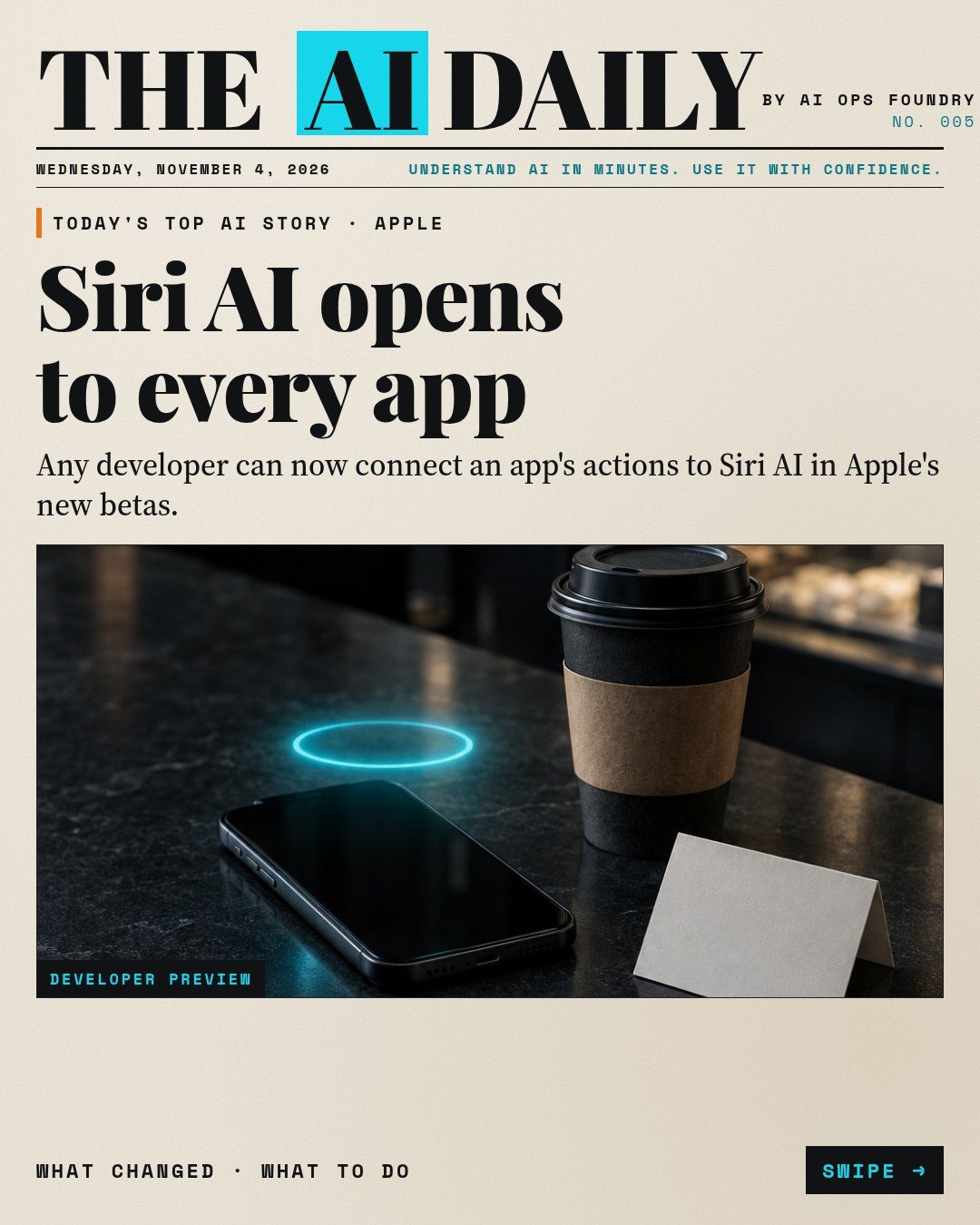
Apple says any developer can now connect their app to Siri AI. A new Developer Preview, starting with the iOS 27.3, iPadOS 27.3, macOS 27.3 and visionOS 27.3 betas released on November 3, lets apps bring their content and actions into Siri AI. Apple says it will first ship to customers "in a few months," and App Store submission opens in the spring. (Apple Developer News)
What changed
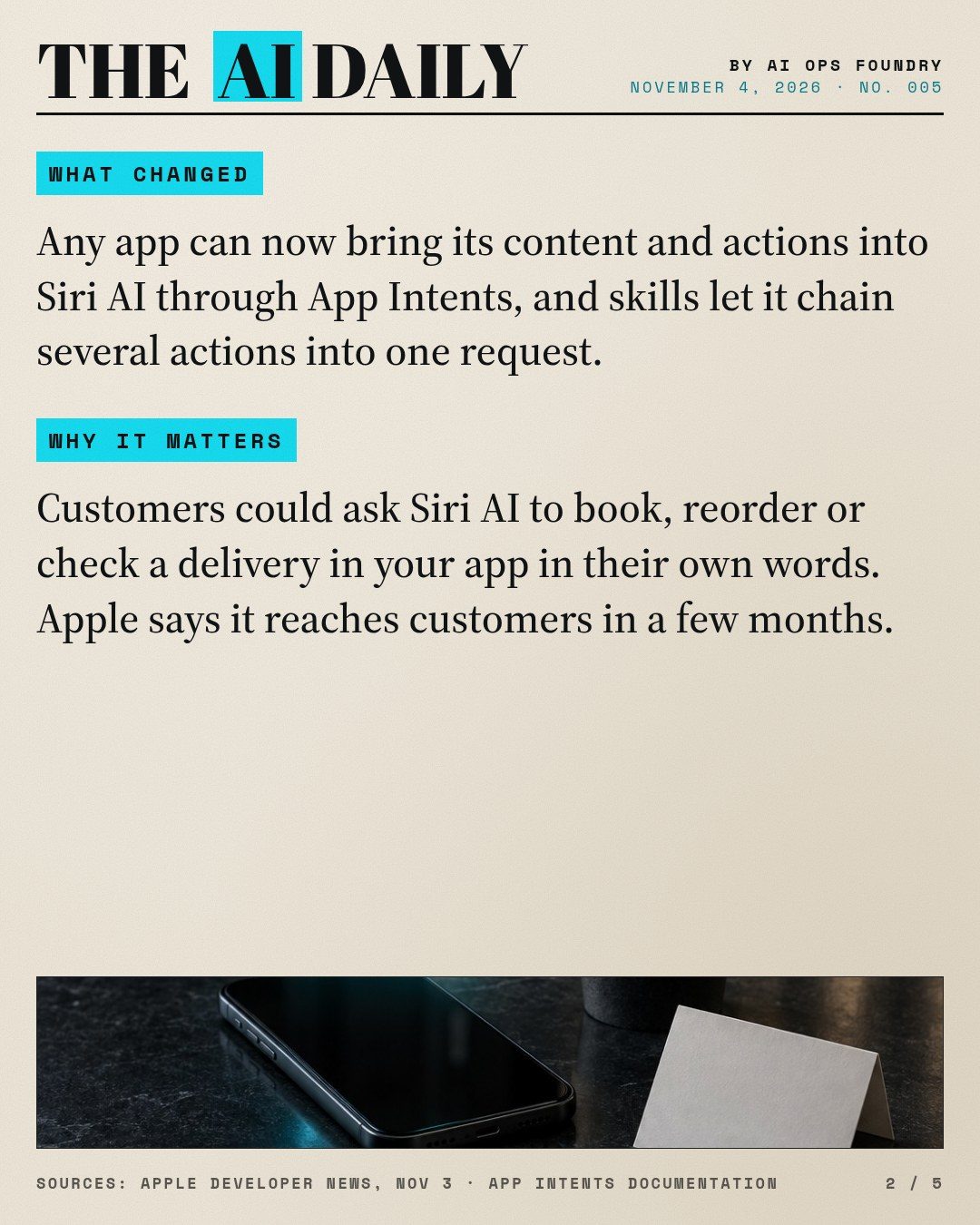
- Any app can now bring its content and actions into Siri AI using App Intents, Apple's existing framework for describing what an app can do. (Apple Developer News, App Intents documentation)
- People can ask in their own words, and Siri AI carries out the custom action the app has built. Apple's examples include checking a delivery, booking a reservation and placing an order. (Apple Developer News)
- New "skills" let developers teach Siri AI to combine several actions into a single request. (Apple Developer News)
- Siri AI can now surface any entity in the Spotlight semantic index, not only ones that fit an existing schema. (Apple Developer News)
- Apple has started rolling out these capabilities across its own apps, including Calendar, Files, Mail, Maps, Messages, Notes, Reminders, Safari and Shortcuts. (Apple Developer News)
Limits Apple lists
- It is a developer beta. It requires an Apple Intelligence-enabled device set to a supported language: English, French, Japanese, Korean, Portuguese or Spanish.
- Siri AI is currently unavailable in the EU on iOS, iPadOS and watchOS, and is not available for users under 13.
- Some Apple Intelligence features that use server-side models, including Siri AI, have daily usage limits. Apple says expanded access will be available for a fee in the future.
- Apple says it will share more details later about terms and usage policies for experiences built on Siri AI.
Why it matters
If customers reach your business through an iPhone or Mac app, such as a booking, ordering or loyalty app, this is the start of a new front door. Instead of opening the app and tapping through menus, a customer could ask Siri AI to book, reorder or check on something in their own words, and your app does the work. The businesses that have their most common actions ready when this reaches customers will be the ones Siri AI can actually help with.
How to use it: step by step
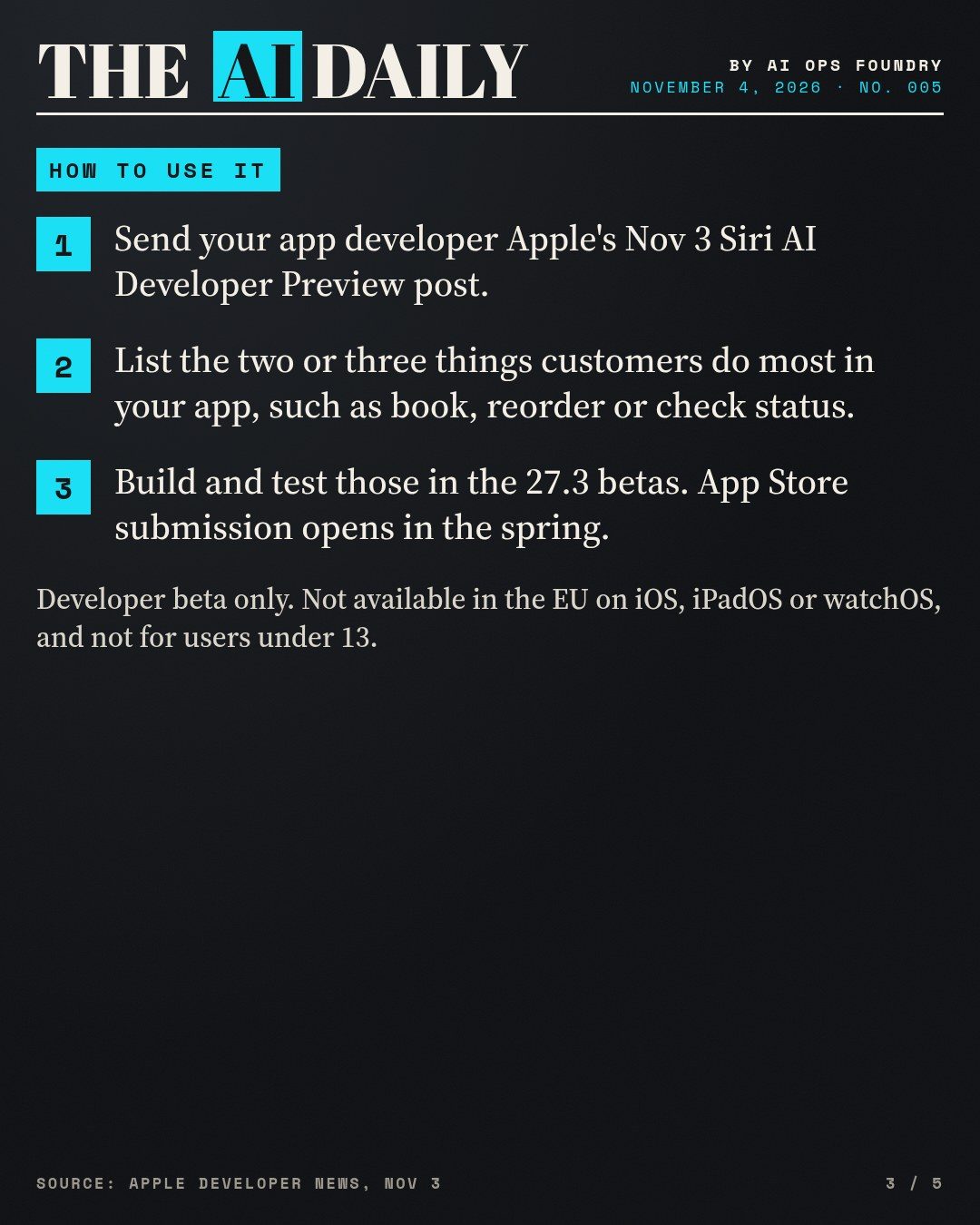
- Send your developer the source. Forward Apple's November 3 post, "Siri AI is now open to all developers," on Apple Developer News, along with the App Intents documentation.
- Pick the two or three actions customers use most. For example: book an appointment, reorder a usual item, check an order or appointment status. Keep the list short; these are what your developer exposes to Siri AI first.
- Build and test in the 27.3 betas. Your developer adds or updates App Intents for those actions and tests them with Siri AI on a test device. Apple is holding Apple Intelligence Group Labs on November 4 and 5 for questions. (Apple Developer News)
- Plan the timing. App Store submission opens in the spring, and Apple says customers get Siri AI integrations "in a few months." Treat this as preparation now, not a feature your customers can use today.
- Don't promise it yet. Until Apple publishes its terms and the feature ships, don't tell customers they can book with Siri AI.
If you don't have an app, this still matters: customers who use Siri AI will increasingly expect to ask for things in plain language. Your booking page and listings should answer the most common questions clearly.
Also today
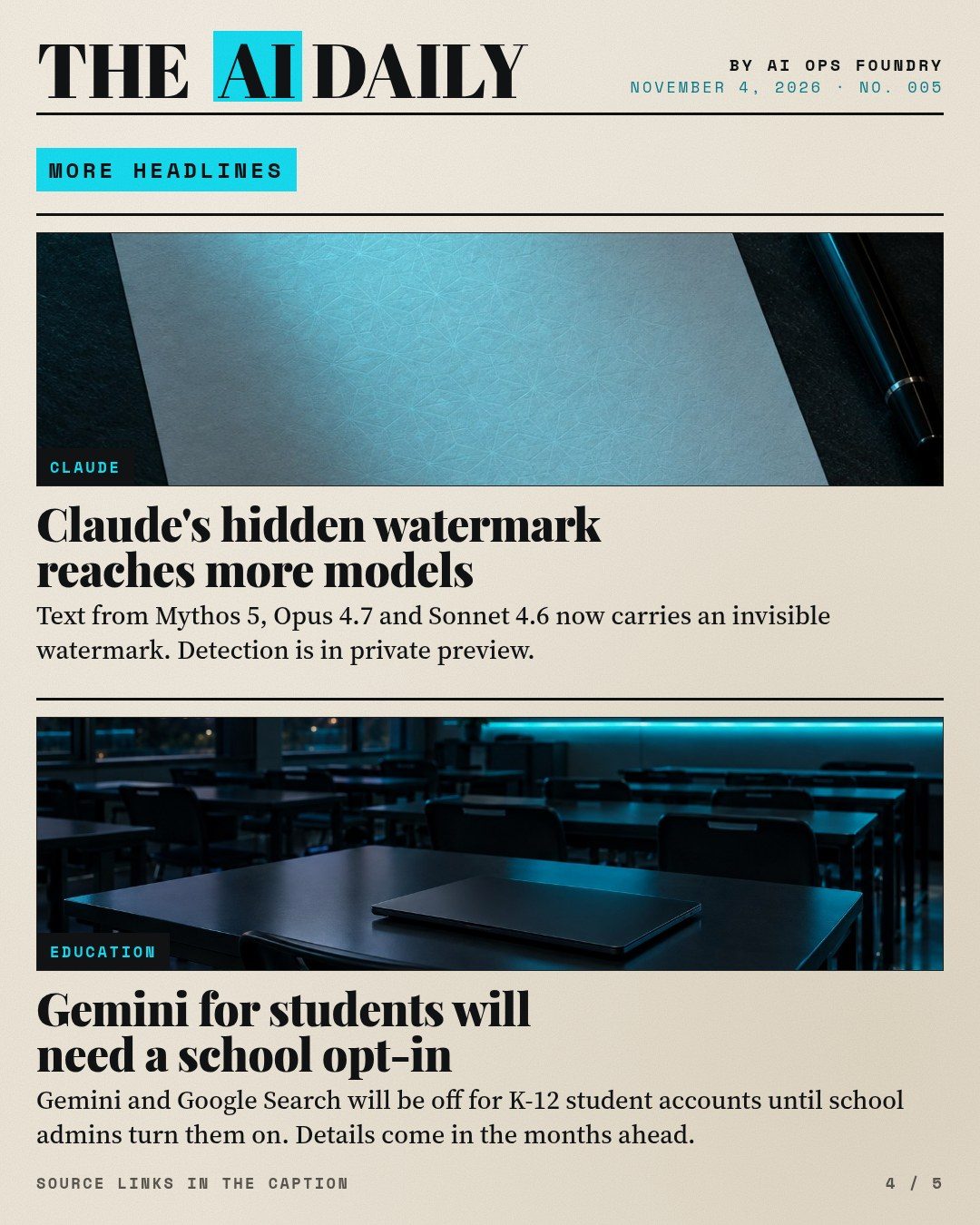
Claude's hidden watermark reaches more models
Anthropic says text generated by Claude Mythos 5, Claude Opus 4.7 and Claude Sonnet 4.6 now carries its text watermark, as of November 3. On Sonnet 4.6, text from requests that set temperature, top_p or top_k to non-default values might not carry it. (Claude Platform release notes) The watermark is invisible, does not change the meaning or quality of the text, and adds no tokens or hidden characters. Detection is in private preview for eligible organizations, such as regulators, media, fact-checkers and researchers, and the cloud-partner rollout on Amazon Bedrock is due to finish by November 10. (Claude Help Center) Anthropic says a detected mark only shows Claude was likely involved, not that Claude wrote the text. (Anthropic)
What to do: nothing changes in how you use Claude. If your team uses Claude for customer-facing writing, edit and fact-check it as your own work, and be open about using AI where your industry or clients expect it.
Gemini for students will need a school opt-in
Google says access to Gemini, Gemini Notebook, Gemini in Classroom and Google Search will be entirely off for K-12 student accounts until school administrators explicitly turn them on. Google will share more details with schools in the coming months, before the change rolls out. Guided Learning, which coaches students step by step instead of giving final answers, is available globally in Google Classroom from November 3, and a Guided Learning pilot in Search starts in select US schools later this month. (Google)
What to do: if you run a tutoring, after-school or training business that works with school accounts, check with your schools which AI tools they plan to enable before you build lessons around them.
Recommended tools for today's lesson
- Apple Developer News and App Intents documentation: the primary sources to share with your developer.
- Xcode 27.3 and the 27.3 betas: what your developer uses to build and test Siri AI actions.
- A simple list of your top customer requests: the starting point for any assistant integration.
Quick tip: what to try today
Write down the three questions customers ask your business most. Those are the first actions worth making easy to ask for, in Siri AI or any assistant.
The edition in slides
The same story as the Instagram and Facebook carousel. Swipe or scroll; select a slide to open it full size.
Sources
- Apple Developer News, Nov 3
- App Intents documentation
- Claude Platform release notes
- Claude Help Center
- Google, Nov 3
Every fact is from the official sources listed above, checked on the day of publication. See how we label AI news.